

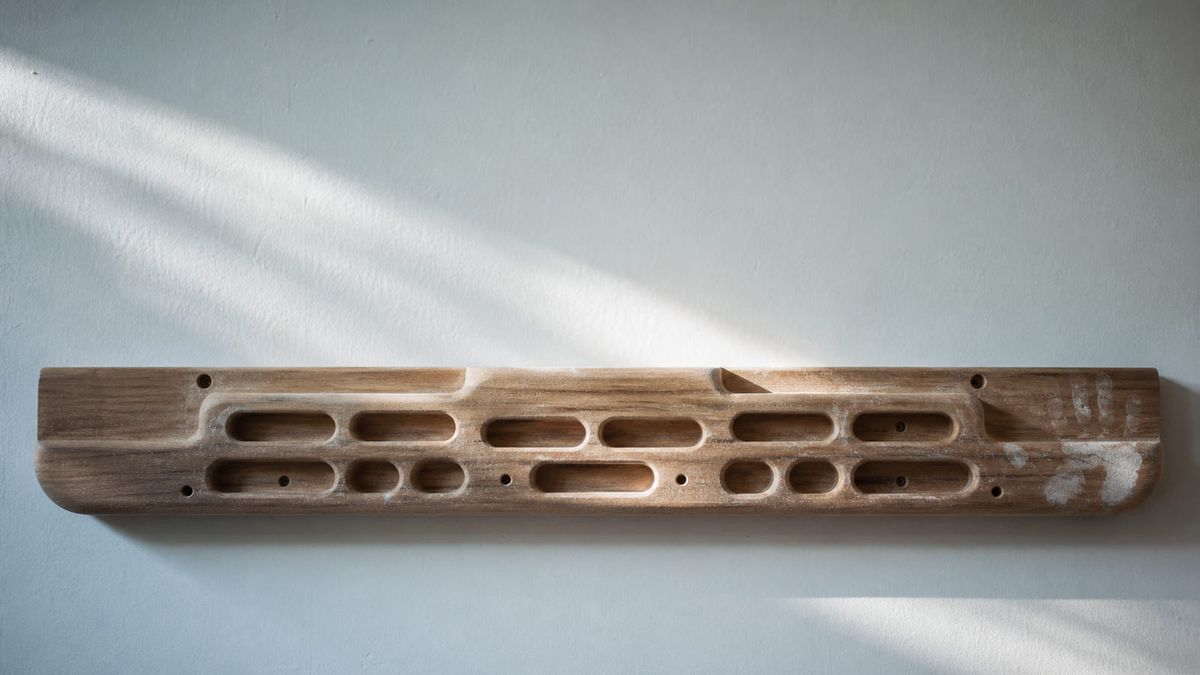
Hangboard two to three times a week, with at least 48 hours between sessions. Beginners with a year of climbing behind them need two; advanced climbers who recover well can earn a third. The successful studies used modest frequency, and more sessions rarely beat better-structured ones. The catch is the accounting: count every hard finger day, including limit bouldering, not just the days you touch the board.
Key takeaways
- 2 to 3 sessions per week with at least 48 hours between them covers almost every climber below elite level.
- Both successful intervention studies used only 2 sessions per week: Mundry et al. (2021) over 8 weeks, and the Beastmaker app study (PMC9092147) over 10 weeks with two 48-minute sessions.
- Two hangboard sessions plus two limit-bouldering sessions is four hard finger exposures in a week, not two.
- You can train fingers on a climbing day if the two are 4 to 6 hours apart; sharp pain buys 48 to 72 hours of extra rest, not a push through the set.
The short answer by level
Two sessions a week is the default. Three is something you earn. Frequency tracks your training age, not your ambition, because what limits you is how fast connective tissue recovers, and that does not speed up because you want it to.
| Level | Sessions per week | What decides it |
|---|---|---|
| Beginner (~1 year climbing) | 2 | A base of climbing volume first, then two light sessions |
| Intermediate | 1–2 dedicated | Often only one, because climbing already loads the fingers |
| Advanced | 2, sometimes 3 | The third is earned by proving recovery |
| Elite / competition | up to ~5 | Tightly managed, with coaching and monitoring |
Dr. Tyler Nelson’s recommendation lands in the same place: 2 days a week for beginners, 3 for experts. Notice how narrow that range is across an enormous span of ability. A climber at their first V4 and a climber projecting at the top of the grade scale are separated by one session per week.
“Earning” the third session is a real test, not a mood. It means your finger soreness clears before the next session, your climbing performance is not sagging across the week, and the loads in your log are still going up. If any of those is false, the honest answer is that you are already at your frequency ceiling. Rating each session’s effort gives you the evidence to decide, and the RPE scale for climbers is how to record it without guessing.
The common mistake at intermediate level is adding a session because progress stalled. Stalled progress after eight weeks is usually a load or structure problem, not a frequency problem, and a third session buries the evidence under fatigue.
What the studies used
The protocols that produced measurable strength gains ran at two sessions per week. That is the single most useful fact about hangboard frequency, and it is the one most training plans quietly ignore.
Mundry et al. (2021) trained climbers twice a week for 8 weeks and saw grip strength improve significantly. The Beastmaker app study (PMC9092147) ran 10 weeks of two 48-minute sessions per week and raised both peak and average force. Neither research group needed daily hanging, four sessions, or a session on every rest day to move the numbers.
Two 48-minute sessions is worth sitting with. That is roughly an hour and a half of finger training in a week, warm-up included, and it was enough to change measured force output over ten weeks. The reason is that hangboarding is not a volume sport. Each near-maximal hang is a short, high-intensity signal, and the adaptation happens in the days between signals. Sending the signal more often does not make it louder; it just leaves less time to respond to it.
The practical consequence is that if your plan is not working, frequency is the last variable to touch. Intensity, edge, grip position and progression all sit above it, and all of them belong to the session itself rather than the calendar. The three hangboard methods and the numbers behind them is where those choices get made; max hangs and repeaters are different tools, and running the wrong one twice a week for two months is a structure error that a third session cannot fix.
The mechanism also explains why elite climbers can go higher. Five sessions a week only works when most of them are not maximal, when someone is monitoring the load, and when the athlete has years of accumulated tissue tolerance behind them. Copying the frequency without the other three is how a strong intermediate ends up injured.
Count total finger load, not hangboard days
Your fingers do not know which piece of equipment loaded them. A week of two hangboard sessions plus two limit-bouldering sessions is four hard finger exposures, not two, and every frequency guideline on this page applies to that total.
This is where most overtraining starts, and it starts as an accounting error rather than a discipline problem. The climber genuinely believes they are hangboarding twice a week, which is true and irrelevant. Limit bouldering on small holds is a maximal finger effort with worse control than a hang: the load arrives suddenly, the grip position is whatever the hold dictates, and you cannot stop mid-move.
Work through a normal week. Monday hangboard, Tuesday limit boulder, Thursday hangboard, Saturday limit boulder. On paper that is a twice-weekly hangboard plan with three rest days. In tissue terms it is four maximal finger days out of seven, with a 24-hour gap between Monday and Tuesday. The Monday-to-Tuesday pair breaks the 48-hour rule even though neither day looks like a violation on its own.
Here is the fix, and it is a subtraction rather than an addition. Keep one column in your log for hard finger days and put everything in it: hangboard sessions, limit bouldering, small-hold board sessions, and maximal work like block pulls or lifting-edge sets. The finger-strength exercises worth programming all belong in that column too, because a heavy no-hang is a maximal finger effort whatever the equipment looks like. Then cap the column at your level’s number: two for most people, three if you have earned it. If you want to add a hangboard session, something else in the column has to come out or come down.
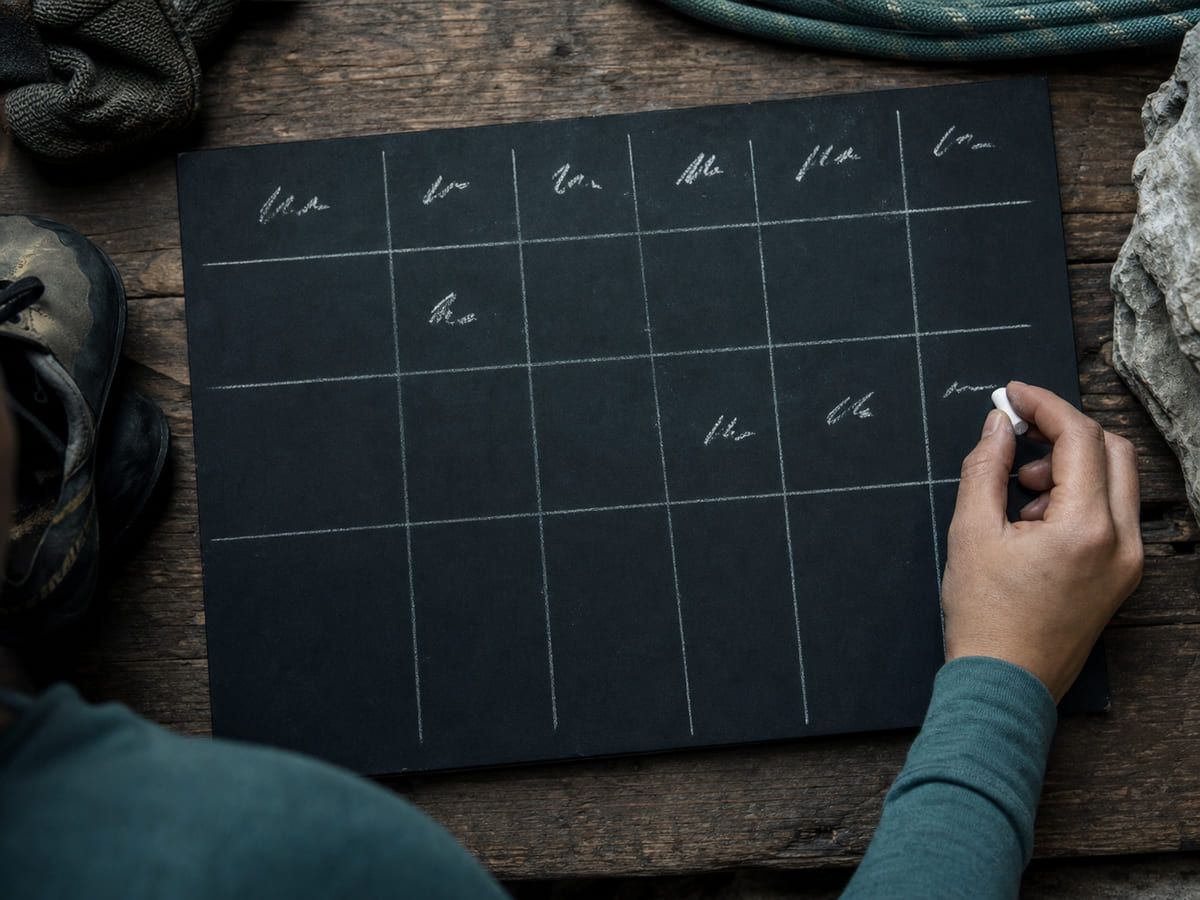
The version of this that catches good climbers is a strong week outdoors or a project session that ran long. Those days count. A frequency plan that only tracks the sessions you scheduled will always undercount the ones you actually did, and undercounting is how a plan that looks conservative on paper delivers five maximal finger days in a week.
Rest and recovery
Leave 48 to 72 hours between hard finger sessions, and treat the upper end as the default after a maximal one. The gains do not happen during the hang. They happen while you are not hanging, which makes the rest interval part of the protocol rather than the gap between protocols.
Same-day training works if you build the gap in. Nelson notes that fingers can be trained on climbing days when the two sessions are separated by 4 to 6 hours, which lets the pulleys rehydrate between loads. That separation is what turns a double day from a compounding error into a sensible way to protect your genuine rest days, because two hard efforts on one day still leaves the next day clear.
Sharp pain is a full stop. It means more rest, not a modified set or a lighter grip, and it is the one signal that overrides everything else on your calendar. What to do next, and how finger injuries are actually graded, is covered in the guide to finger pulley injuries.
Read that finding carefully, because it is the strongest argument against high frequency available. A daily protocol was tested against twice a week and came out level. Seven exposures bought nothing over two, which means the extra five days were not training, they were only risk. Rest weeks work the same way at a longer timescale, and planned deload weeks are where a block of hard finger work finally shows up as strength.
Sources
- Mundry, S. et al. (2021). Scientific Reports, 11, 13530.
- Beastmaker app hangboard training study (PMC9092147)
- Gilmore, et al. (2024). Abrahangs compared with twice-weekly max hangs.
- Nelson, T. Hangboard frequency recommendations: 2 days per week for beginners, 3 for experts.
Common questions
Can I hangboard every day?
Not at high intensity. Daily max hanging is a reliable route to overuse injury in the fingers. Only very light protocols such as Abrahangs, which are low-intensity no-hangs, have any support for daily use, and Gilmore et al. (2024) found them comparable to, not better than, twice-weekly max hangs.
Should I hangboard 2 or 3 times a week?
Two hangboard sessions a week is enough for most climbers, and it is the frequency the successful training studies actually used. A third session suits advanced climbers who recover well and can prove it: no lingering finger soreness, no drop in climbing performance, and still 48 hours between every hard finger session.
How much rest do I need between hangboard sessions?
Leave at least 48 hours between hard finger sessions, and 48 to 72 hours after a maximal one or when your fingers still feel yesterday's work. Hangboarding loads tendons and pulleys that adapt more slowly than muscle does, so the rest day is not lost training, it is when the adaptation happens.
Can I hangboard on climbing days?
Yes, if you separate the hangboard session and the climbing by 4 to 6 hours, which gives the pulleys time to rehydrate between loads. Pairing finger work with a climbing day also keeps your hard days and your easy days apart instead of smearing load across the whole week.

Jan Luther is a climber and the developer behind Boulder Trainer, the hangboard app with guided workouts, voice coaching and a habit tracker.
Keep reading
Hangboard Training: The Complete Guide for Boulderers
Everything a boulderer needs to train fingers safely: the three main hangboard methods, the research behind them, load and edge guidelines, and a beginner-safe first protocol.
Deload Weeks: Why Training Less Builds More Progress
A deload isn't lost time — it's when adaptation happens. Here's how to program a deload week, what to reduce, and the science of why less becomes more.