

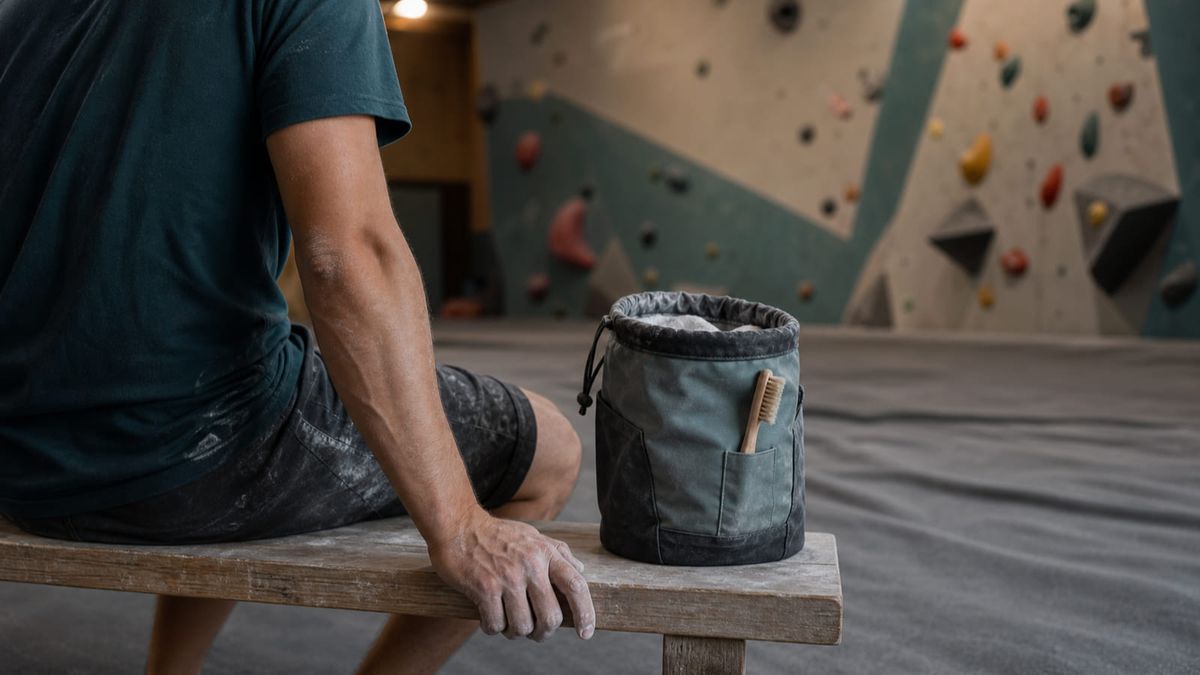
A deload week is a planned reduction in training load, usually every fourth week after three progressively harder ones. You do not stop; you cut volume and intensity so the body can supercompensate and turn accumulated stress into strength. Skip deloads and progress stalls, then something in a finger gives. The fingers are where it shows first, because tendon and pulley tissue adapts more slowly than the muscle pulling on it.
Key takeaways
- The default structure is 3 build weeks + 1 deload, which puts a planned reduction in load in every fourth week.
- In the deload week, cut volume by 30–50% and remove max-intensity finger work completely.
- Four things go first: max hangs, limit bouldering, campus board and total sets. Easy technical climbing, antagonist and prehab work and light movement all stay.
- One week of reduced load builds gains rather than erasing them, because fitness rebounds above baseline once fatigue clears.
The science — supercompensation
Hard training makes you temporarily worse. Every session creates fatigue and a short-term dip in performance, and the fitness gain only appears once that fatigue has cleared. Supercompensation is the name for what happens next: given adequate recovery, the rebound overshoots and settles above where you started.
That two-part response is why the calendar matters as much as the effort does. Fatigue rises fast and clears fast. Fitness rises slowly and decays slowly. Stack a new hard week on top of unresolved fatigue every single time, and the fatigue curve never comes down far enough for the fitness curve to show. What you read off the wall on any given day is the sum of the two, not the size of either.
A deload is how you cash in the rebound instead of digging a deeper hole. Three weeks of accumulating stress push fatigue high; one week of reduced load lets it drain while the fitness you built stays roughly where it is. What you feel in week five is not a new adaptation. It is the adaptation from weeks one to three, finally visible.
The common mistake follows directly from that lag. Climbers judge a block by how the block felt, so the last hard week reads as failure: the warm-up problems feel like projects, the hangboard load you held twice already feels impossible, and the obvious conclusion is that the plan is not working. It is usually the opposite. That heaviness is accumulated fatigue sitting on top of work that has already been done, and the only way to find out is to back off for a week and look again.

How often and how much
Three build weeks, then one deload. Weeks one to three ramp up, week four backs off, and the cycle repeats. The ramp matters as much as the drop: if all three build weeks are identical, you are not building, you are repeating, and the deload has nothing to release.
In the deload week itself, reduce the load meaningfully. Cut volume by 30–50% and remove max-intensity finger work entirely. Meaningfully is the operative word, because a 10% trim feels responsible and changes almost nothing. The fatigue you are trying to clear was built across three weeks of accumulation, not in one afternoon, so the reduction has to be big enough to register against three weeks of load.
A worked example. Say a build week puts you on the wall three times: two bouldering sessions of six hard problems each, plus one hangboard session of five sets. A 30–50% cut takes you to three or four problems per session and two or three hangboard sets, all of it well below maximum, with the top-end efforts gone. Same three slots in the week, roughly half the stress.
3+1 is a rhythm rather than a rule, and it sits inside whatever larger structure you are running; the periodization models and their phase names live in the bouldering training plan. Some climbers hold 3+1 for years. Others need to back off more often, and there is nothing wrong with that.
What decides it is everything the training plan does not contain. A week of bad sleep, a stressful month at work or an illness you trained through all draw on the same recovery budget as the sessions do, and none of them appear in your log. Two climbers running an identical program can genuinely need different deload frequencies, which is why the honest version of the rule is “every fourth week, unless the evidence says sooner” rather than a fixed date in the calendar.
The calendar is a default, not a diagnosis. Rate each session as you go and the schedule stops being guesswork: the RPE scale for climbers is the cheapest way to notice that week three has quietly turned into the week you should already be deloading.
What to cut (and keep)
Cut intensity first, then volume. The high-cost items go completely, and whatever survives gets trimmed by 30–50% in total sets. Everything that keeps you moving without loading connective tissue hard stays exactly where it is.
| Cut in a deload week | Keep in a deload week |
|---|---|
| Max hangs | Easy technical climbing |
| Limit bouldering | Antagonist and prehab work |
| Campus board | Light movement and mobility |
| 30–50% of total sets | The session slots in your week |
Intensity leads because near-maximal effort is what your fingers are actually recovering from. Keeping one max hang “just to check” defeats the whole week: a maximal effort is maximal whether it is the first set or the fifth, and it re-triggers the exact stress response you scheduled the week to resolve. The urge to run that check is itself worth noticing — it means you do not trust the week, and a deload you do not trust turns into a light training week within about three days.
Cutting volume without cutting intensity is the more common version of the same error, and it is more convincing because the numbers look right. Half the sets, same top-end load, sessions that end early: the log says deload and the fingers say Tuesday. Connective tissue responds to peak load far more than it responds to how many times you reached it.
Limit bouldering belongs on the cut list for the same reason, which is the part most people miss. A hard boulder is finger training with a different name on it, so a week that reads as a deload on your hangboard log can still be a normal week for your fingers. Counting total finger load is what makes a deload week honest instead of nominal.
The keep column is not filler. Easy technical climbing preserves movement quality, footwork and the feel of holds, none of which survive a week of doing nothing. Antagonist and prehab work is low-stress by design and is usually the first thing dropped in a build week, so a deload is when it finally gets done. Keeping the session slots also keeps the habit intact, which matters more than it sounds; the psychology behind a training streak explains why the empty week is the one that turns into three.

When to deload early
A deload you did not plan still counts. Illness, a work trip, a week of terrible sleep with no training in it: that is a deload. Resume where you left off rather than compressing the missed sessions into the following week, because “making it up” is how a forced break turns into a fourth build week and cancels the recovery you just got for free.
Four cues say deload now rather than next week. Persistent fatigue that a single rest day does not touch. Nagging finger tweaks that show up in the warm-up and fade once you are pumped. Week-over-week performance decline on problems you have already done. And motivation that has quietly disappeared, which is a physiological signal more often than climbers give it credit for. Disrupted sleep belongs on the same list: it degrades recovery and is caused by the load you are trying to recover from, which is a loop that does not resolve on its own.
Sharp finger pain is different in kind. It is not a scheduling signal, it is a stop signal, and the right response is to stop the session rather than finish the set. Crimped positions on limit boulders multiply the load on the finger pulleys by a wide margin, and the recovery timelines once one is damaged run in weeks to months, not days; finger pulley injuries covers the anatomy, the grading and what going back too early costs you.
Weigh those two timescales against each other and the arithmetic is not close. A deload taken a week early costs you one week of reduced training. A deload skipped until something tears costs a season.
Sources
- Vigouroux, L. et al. (2006). Journal of Biomechanics, 39, 2583–2592.
- Return to sport after finger pulley injury (2022). BMC Sports Science, Medicine and Rehabilitation.
Common questions
How often do I deload?
Typically every fourth week: three progressively harder build weeks, then one week of reduced load. The interval is a default rather than a law. Heavy finger training, a demanding job or a stretch of bad sleep all push it shorter, and a deload taken early is never the expensive mistake.
Do I stop climbing during a deload week?
No. A deload week reduces load, it does not remove it. You keep easy technical climbing, antagonist and prehab work and light movement, and you drop the max efforts. The point of a deload is to reduce stress, not to spend the week on the couch losing movement quality.
How much should I cut in a deload week?
Roughly 30 to 50 percent of your volume, plus every max-intensity effort. In practice that means going from six hard boulder problems per session to three or four, cutting max hangs, limit bouldering and campus work entirely, and keeping your hardest problem well below your project grade.
Will I lose fitness during a deload week?
No. A single week of reduced load builds gains rather than erasing them. Strength adaptations lag behind the training that produced them, so the week you back off is usually the week the previous three weeks of work finally becomes visible as performance on the wall.

Jan Luther is a climber and the developer behind Boulder Trainer, the hangboard app with guided workouts, voice coaching and a habit tracker.
Keep reading

Bouldering Training Plan: Periodization for Home & Gym
Stop training randomly. Here is how to structure a bouldering plan into base, strength, power and deload phases — and how to pick linear, block or undulating periodization for your life.

RPE in Climbing: Train Hard Without Overtraining
Fixed percentages assume you're identical every day — you aren't. Here's how RPE and autoregulation let you match load to how your fingers actually feel, backed by strength science.