


Habits beat motivation because motivation is unreliable and a habit runs on its own. Lally et al. (2010) found a new behavior takes a median of 66 days to become automatic, with a range of 18 to 254 days, and missing a single day does not reset the process. Streaks work because losing one hurts. They fail when they punish rest.
Key takeaways
- A new behavior took a median of 66 days to become automatic in Lally et al.’s study of 96 people (2010), not the 21 days of the myth.
- The range ran from 18 to 254 days, so two climbers on the same routine can be months apart in how automatic it feels.
- One missed day did not reset automaticity in Lally’s data; the curve resumed from where it left off.
- Streaks stick because losses feel about twice as strong as equivalent gains (Kahneman & Tversky, 1979), which is also why an all-or-nothing streak collapses after a single break.
Why motivation fails and habits win
Motivation is a feeling, and a feeling is a poor scheduling system. It spikes after a good session or a strong week and crashes on the Tuesday you slept badly. A habit works differently: it is a behavior triggered by a cue, running with almost no conscious effort, which is what carries it through the weeks when you do not care about training at all.
The cue is the whole mechanism. Every stable habit hangs off something that already happens without your involvement, so the decision is made before you are awake enough to argue with it. Anchoring is the most reliable way to build one: after the coffee you drink at the same time every workday, do a five-minute finger warm-up. The old behavior pulls the new one along behind it.
Two rules make an anchor hold. Pick a cue you genuinely never miss, because a habit attached to “when I get home early” inherits every disruption that phrase contains. Then make the anchored version small enough that a bad day cannot beat it. A five-minute routine survives a head cold, a deadline and a delayed train; a full session does not, and a habit that only fires under good conditions never accumulates the repetitions it needs.
The practical consequence is that the habit’s job is not to make you strong. Its job is to guarantee the sessions happen, so that a structured bouldering plan has something real to organize. The common mistake is to build a routine that works only when you feel like training, then read the eventual collapse as a discipline problem. It was a design problem, and it had a design fix.
The 66-day reality
Automaticity plateaued at a median of 66 days in Lally et al.’s (2010) study, which tracked 96 people repeating a chosen daily behavior and measured how automatic it felt over time. The often-quoted 21 days is not a research finding. It is a number that escaped from a different context and never came back.
The range matters more than the median: 18 to 254 days. Same idea, same effort, and one person is finished inside three weeks while another is still consciously deciding eight months later. Nothing about the fast group makes them tougher. Simpler behaviors automate faster, and the size of the behavior you chose is the variable you actually control.
The second finding is the reassuring one. A single missed day barely dented progress in Lally’s data; automaticity recovered quickly after a lapse rather than starting over. Repetition builds the cue-behavior link gradually, so one absent repetition removes very little of what the previous weeks put there. That is the opposite of how most training apps frame a break, and it is the reason a broken streak is not the same event as a broken habit.
Two consequences follow. The honest metric is not consecutive days but whether the decision still costs you anything, so ask each week whether the session is something you do or something you talk yourself into. And week three is the most common quitting point precisely because it still feels effortful there. At day 21 the median climber is roughly a third of the way to automatic, which is exactly what being on schedule looks like from the inside.
One caveat if the habit you are anchoring is finger training: fingers do not tolerate a daily cadence, and how often you can hangboard sets the real ceiling.

How streaks help — and where they hurt
Streaks work because losing one hurts more than building it felt good. Kahneman and Tversky (1979) established loss aversion: a loss weighs about twice as much as an equivalent gain. Once a chain exists, it becomes something you own, and the prospect of losing it pulls harder than the prospect of adding another link. That asymmetry is the entire engine.
The same engine drives the failure. Evidence from streak-heavy apps shows three recurring problems: genuine streak anxiety, performative filler activity, and higher quitting rates after a break. Filler activity is the clearest tell. When the number is what you are protecting, the cheapest action that keeps it alive starts to count as a session, and you end up with a long chain of days that trained nothing.
The quitting pattern follows from the same logic. If the streak is the asset, breaking it destroys the asset, and there is no obvious reason to start a new one from zero. That is how a climber with a long chain disappears for a month after one missed Thursday. Lally’s data says the habit underneath was barely affected by that Thursday. The scoreboard said it was ruined, and the scoreboard is what people believe.
The design lesson is capped, forgiving streaks with built-in rest days. Streak protection, a freeze, a weekly target instead of a daily one: any mechanic that makes a missed day survivable removes the cliff without removing the motivation. Treat the streak as a commitment device for showing up, never as a measure of how hard you trained, because a streak counts days and cannot tell a maximal session from an easy one. That is what the RPE scale is for.
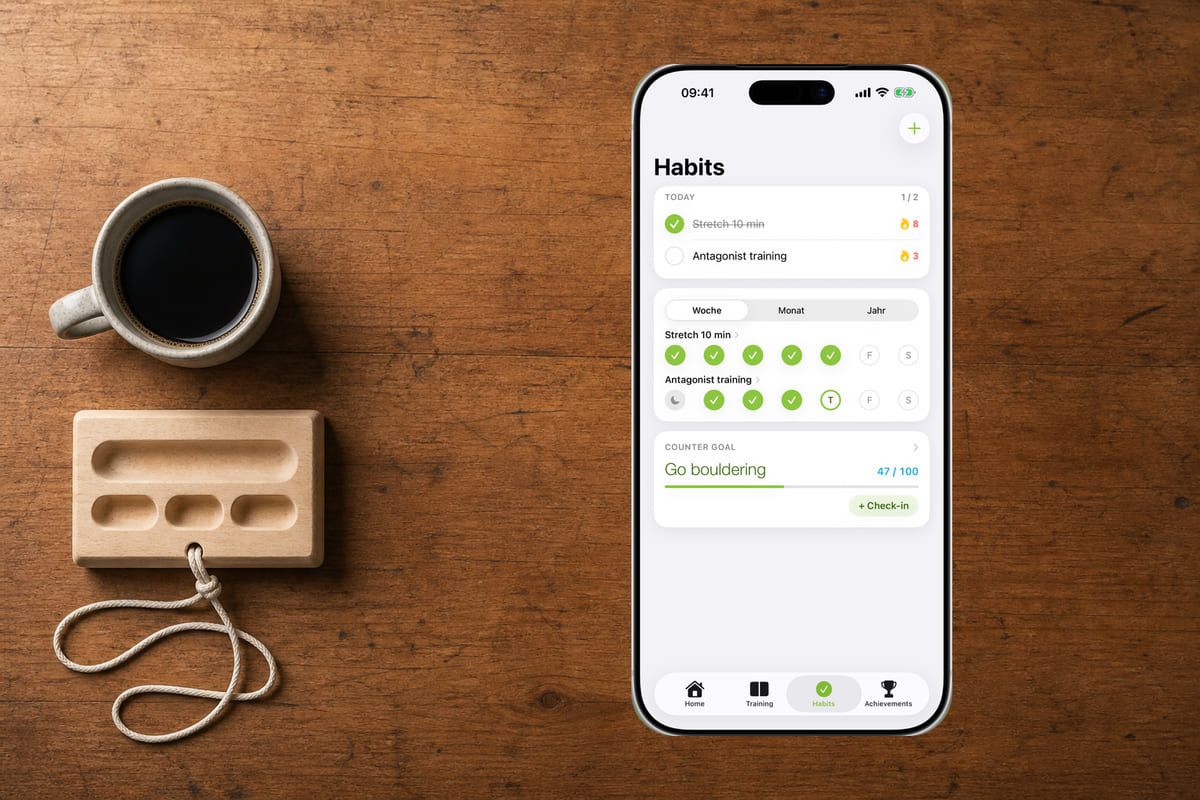
Streaks for climbers specifically
A daily climbing streak is a bad streak. Climbing requires rest days to work at all, so a chain that only advances when you train hard rewards exactly the behavior that flattens your season. Fingers, tendons and pulleys adapt on a slower clock than enthusiasm does, and a streak has no way of knowing that.
The fix is to change what the streak counts. Count planned sessions completed rather than consecutive hard days, and let a rest day or a mobility session count as completed when the plan called for one. The chain then measures adherence, which is the thing you actually want to be consistent about, instead of measuring accumulated fatigue.
That single change flips the incentive. Under a daily-training streak, recovery is a loss, so a tired climber trains anyway to protect the number. Under a planned-sessions streak, recovery is a win, and consistency and recovery stop competing for the same square on the calendar. A deload week is the sharpest test of this: it is a planned reduction in load, and any streak worth keeping has to score a completed deload as a success rather than a gap.
In practice that means writing the week down before it starts and letting the streak read from it. A week of planned entries, rest days included, gives you a handful of chances to complete the week instead of a daily chance to fail it. It also removes the daily negotiation that burns most of the willpower people think they are spending on training.
The common mistake here is subtler than overtraining. It is quietly reclassifying rest days as failures, so the plan on paper still contains them while the plan you follow does not, and the first thing you drop in a busy week is the session that felt like it was not doing anything.
Sources
- Lally, P. et al. (2010). European Journal of Social Psychology, 40(6), 998–1009.
- Kahneman, D. & Tversky, A. (1979). Loss aversion.
- Streak-anxiety and streak-freeze/churn evidence from streak-heavy apps (yukaichou.com; ludaxis.io).
Common questions
How long does it take to build a training habit?
Lally et al. (2010) tracked 96 people and found a new behavior took a median of 66 days to become automatic, with a range of 18 to 254 days. A simple training habit automates faster than a complex one, so plan a climbing habit in months rather than trusting the 21-day myth.
Does one missed day ruin a training habit?
No. In Lally et al.'s (2010) data, automaticity kept rising after a missed day instead of resetting, so one skipped session costs a training habit almost nothing. What breaks a habit is a run of missed days long enough to become the new default. Resume at the next scheduled session.
Are training streaks good or bad?
Both, depending on design. A climbing streak that counts planned sessions completed, including rest and mobility days, uses loss aversion to keep you consistent. An all-or-nothing daily streak pushes climbers to train on tired fingers and to quit entirely after the first break. Forgiveness mechanics decide which one you get.
Should I rely on a streak or on motivation?
Build the habit and treat motivation as a bonus. Motivation spikes and crashes, so a training routine that only runs on good days loses weeks every season. A cue-anchored habit plus a rest-inclusive streak keeps sessions happening on the days you do not feel like climbing at all.

Jan Luther is a climber and the developer behind Boulder Trainer, the hangboard app with guided workouts, voice coaching and a habit tracker.
Keep reading

Bouldering Training Plan: Periodization for Home & Gym
Stop training randomly. Here is how to structure a bouldering plan into base, strength, power and deload phases — and how to pick linear, block or undulating periodization for your life.

Deload Weeks: Why Training Less Builds More Progress
A deload isn't lost time — it's when adaptation happens. Here's how to program a deload week, what to reduce, and the science of why less becomes more.