

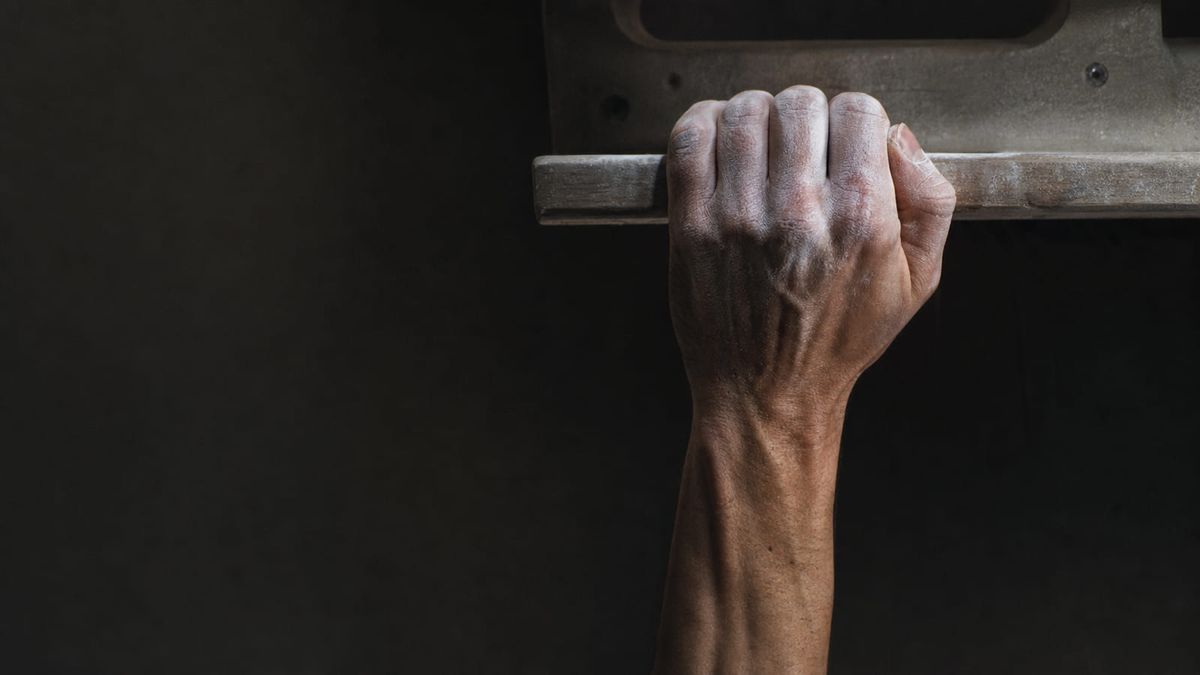
Five exercises cover almost all the finger strength a boulderer needs. Max hangs build peak strength, 7/3 repeaters build strength-endurance, no-hangs and block pulls give precise load with the safest exit, density hangs build capacity, and lifting-edge work is the last progression rather than the first. Train them two to three times a week, 48 hours apart, mostly in half-crimp.
Key takeaways
- Finger flexor strength is the strongest single predictor of climbing ability, in both Schweizer and Hudek’s 2011 work and Lattice Training’s dataset of more than 50,000 athletes.
- Five exercises cover the whole job: max hangs, 7/3 repeaters, no-hangs and block pulls, density hangs, and lifting-edge work.
- Density hangs run 30–60 seconds at moderate load, which makes them the way into a new grip position and the way back after time off.
- Program by phase and train 2–3 times a week with 48 hours between sessions, with the half-crimp as your default grip.
Why finger strength matters most
At intermediate level and above, max finger strength on a 20 mm edge is the best single predictor of the grade you climb. Schweizer and Hudek reported it in 2011, and Lattice Training’s dataset of more than 50,000 athletes says the same thing at scale: of everything you can measure about a climber, what the fingers can hold tracks hardest with what they send.
The mechanism is unglamorous. Your fingers are the only part of you touching the wall on most hard boulders, so every bit of force your legs, back and core produce has to pass through four flexor tendons and stop there. Technique decides how much force you need. Finger strength decides whether that number is available at all.
The practical consequence is that finger strength deserves dedicated, measurable training rather than being left to whatever the wall happens to give you. A bouldering session loads your fingers in a hundred uncontrolled ways and records none of them. A finger session loads them in one controlled way at a load you wrote down, which is the only setup where progressive overload actually means something.
The common mistake is reading “best predictor” as “only thing that matters”. It is a correlation measured in climbers who already move well. If you have been climbing for under a year, your grade is limited by movement, not by tendon capacity, and time on the wall buys more than any exercise below.
The 5 exercises
Three of the five are hangboard protocols and two are not, which is the reason this list is worth having as a list. Max hangs, repeaters and density hangs are defined, dosed and evidenced in the guide to the three hangboard methods and the studies behind them; what follows is how to choose between them, and what the two non-hangboard options add.
| Exercise | Trains | Prescription | Best for |
|---|---|---|---|
| Max hangs | Maximum strength | 4–6 sets × one 5–10 s hang, 3–5 min rest | Experienced fingers, strength phase |
| Repeaters (7/3) | Strength-endurance | 7 s on / 3 s off × 6 cycles = 1 set | Base phase, long boulders, rehab progression |
| No-hangs / block pulls | Maximum strength | Lift a loaded edge from the floor | Beginners, rehab, travel |
| Density hangs | Capacity | 30–60 s at moderate load | New grips, base phase, tired days |
| Lifting / minimum edge | Progression | Incremental steps to smaller edges | Advanced only |
1. Max hangs
Max hangs are the highest-return exercise for a climber whose fingers already have years of load behind them. Four to six sets of a single 5 to 10 second hang, with 3 to 5 minutes between them, is the whole session. The long rest is the exercise, not padding around it: you are training the ability to produce force, and the fourth set only counts if it is as hard as the first.
The common mistake is cutting rest to save time. Take 90 seconds instead of three minutes and you have quietly converted a strength session into a fatigue session at a load high enough to hurt you. Run the arithmetic before you start: six sets with 5 minutes of rest is half an hour of hanging and waiting, and if you cannot give the session that half hour, run fewer sets rather than shorter rests.
2. Repeaters (7/3)
Repeaters build strength-endurance on the Anderson brothers’ 7/3 timing, popularized in The Rock Climber’s Training Manual, and they remain the default base-phase block.
They also make a good first structured finger exercise. Each hold is short enough that a sloppy position gets fixed on the next repetition instead of surviving to the end of a maximal effort, and the gap between holds is deliberately too brief to clear the forearm — which is precisely what produces the endurance adaptation, so stretching it to ten seconds because it feels better turns the set into something else. If your projects are long and pumpy rather than one hard move, this is the exercise that matches the demand.
3. No-hangs and block pulls
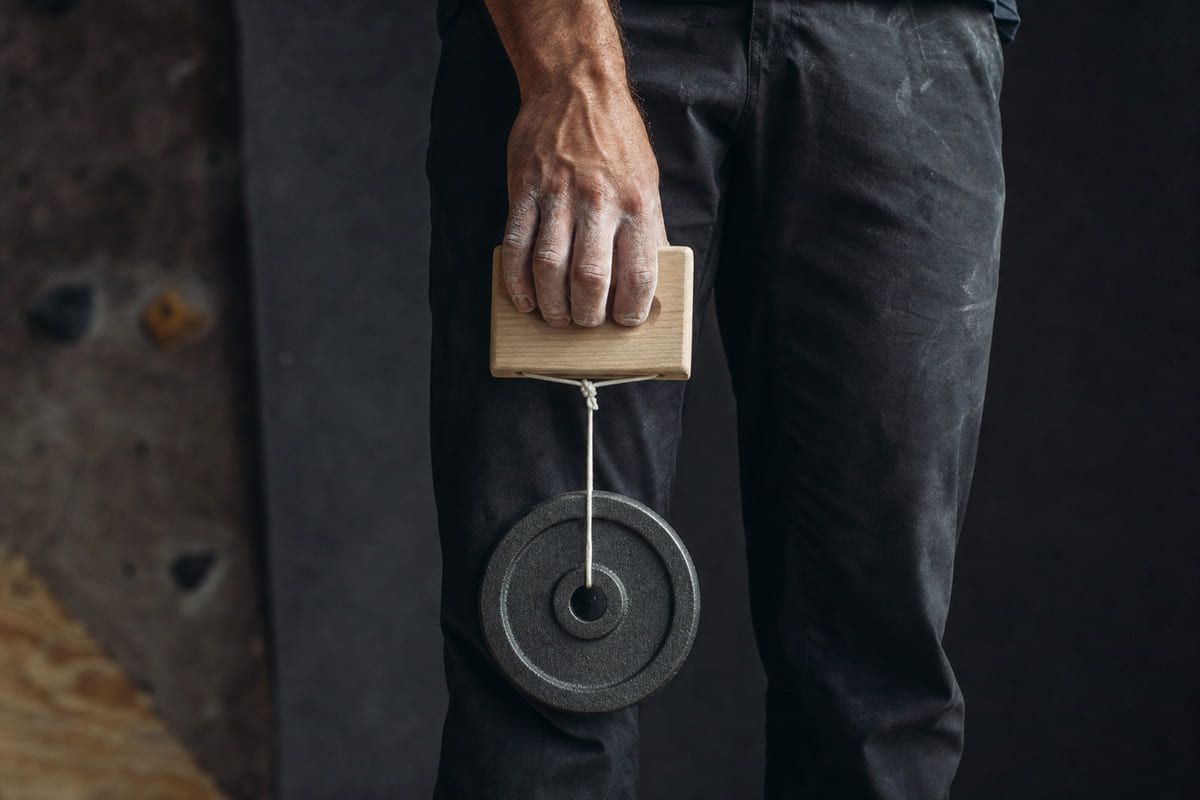
Block pulls are the most controllable finger exercise available, and the one most climbers should start with. You attach a wooden block or edge to a loading pin, stand over it, and lift the plates off the floor. Dr. Tyler Nelson has done the most to popularize the method, and its advantages are structural rather than a matter of preference.
You set the load to the kilogram, which a hangboard cannot do because bodyweight is its floor. You can abort mid-rep by simply letting the plates touch down, instead of dropping off a bar. And the whole setup fits in a bag, so a work trip stops being a lost training block. That makes block pulls the default for beginners, for rehab, and for anyone training away from a wall.
4. Density hangs
Density hangs sit at 30 to 60 seconds under moderate load, and nobody gets maximally strong from them. What they do is build capacity, introduce an unfamiliar grip gently, and keep load going through a period when a maximal effort is a bad idea. They are the safest way to add a new grip position to your training, because you meet it for the first time at an intensity that forgives an imperfect position.
They are also the entry the schedule survives on. Every other exercise here asks you to be fresh; this one does not, so it is what keeps a block intact through the weeks when the rest of your life is not cooperating.
5. Lifting-edge and minimum-edge work
Minimum-edge work progresses toward smaller edges in measured increments — Eva López’s MED protocols run down to 8–10 mm — and it is the fifth exercise on this list for a reason. It is the one that presumes everything above it has already been done for a long time.
Program it as a destination rather than a difficulty setting. Two climbers can arrive at the same session load by hanging more weight or by moving to a shallower edge, and only one of those two roads is reversible on the day your fingers disagree. That asymmetry is why weight comes first in every progression here and edge depth comes last.
How to program them
Pick exercises by phase rather than by preference, and you never have to argue about which one is “best”. A base phase runs density hangs and repeaters: moderate loads, higher volume, the point being capacity and tolerance. A strength phase runs max hangs and block pulls: high load, low volume, long rest. Minimum-edge work waits until both of those phases have been repeated for more than one season.
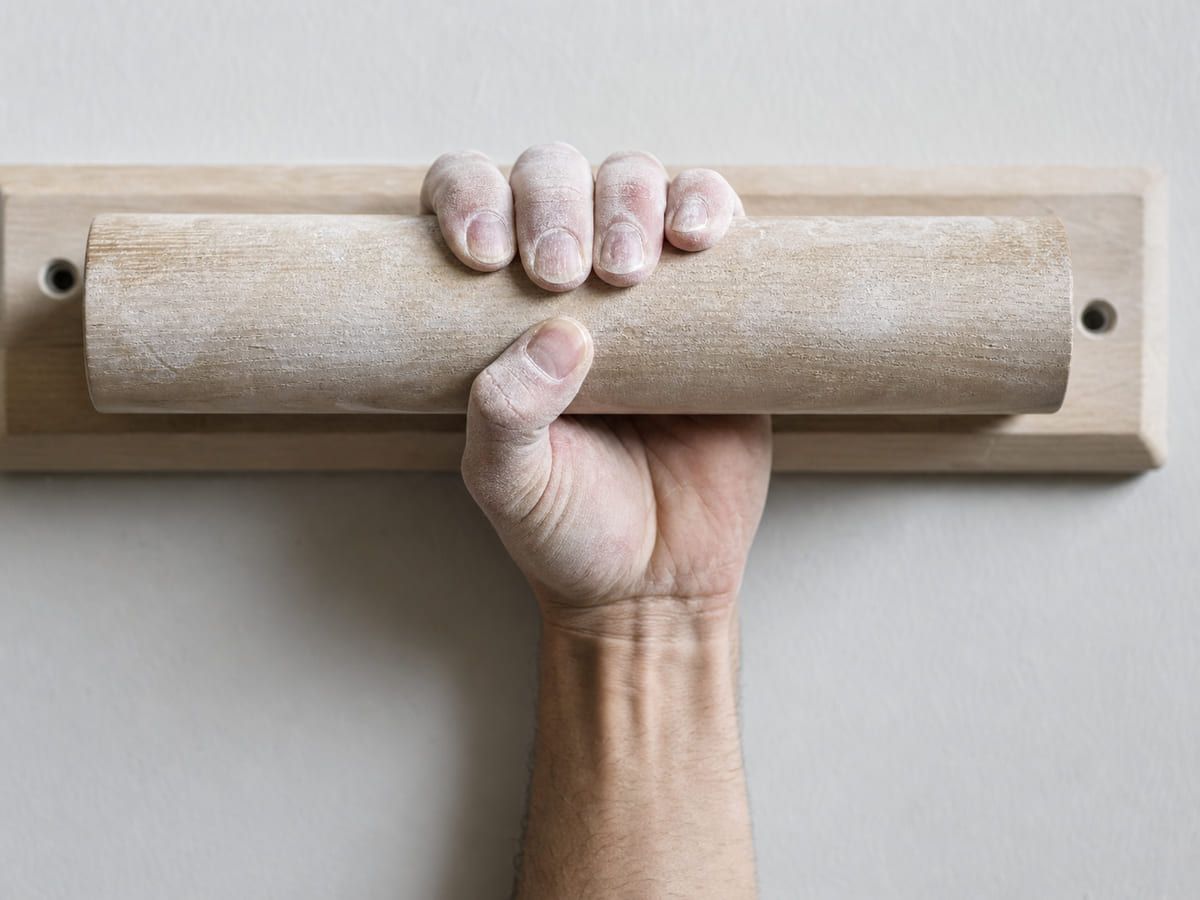
Run all five in half-crimp unless the exercise says otherwise. Keeping one grip constant is what makes the numbers across five different exercises comparable in the first place; the three grip positions and what each does to your fingers explains why that particular one is the sensible constant. Loading a crimped position hard is also the shortest route to a finger pulley injury, which is a much longer detour than a slower progression would have been.
Frequency is where most plans quietly break, because these five exercises are not the only thing loading your fingers in a given week — the accounting behind how often you can hangboard is what stops the total from adding up unnoticed. Explosive contact work is a separate question again; how a campus board compares to a hangboard covers the readiness bar it carries.
A worked week in a strength phase looks like this: max hangs on Monday, hard bouldering on Wednesday, block pulls on Friday, easy climbing at the weekend. Two dedicated finger sessions, 48 hours clear on either side, and the hard bouldering day counted as finger load rather than pretended away. If that week feels thin, that is the point. The adaptation happens between the sessions.
Write down what you lifted, on what, in what position. None of these five exercises rewards you for remembering approximately — the whole reason they beat random climbing is that the load is a number you can raise deliberately, and published blocks run 4 to 8 weeks, which is long enough for an unrecorded “about right” to drift downward unnoticed.
Sources
- Schweizer, A. & Hudek, R. (2011), on finger flexor strength as a predictor of climbing ability.
- Lattice Training, performance dataset of more than 50,000 athletes.
- Anderson, M. & Anderson, M. The Rock Climber’s Training Manual.
- Nelson, T., no-hang and block-pull loading protocols.
Common questions
What is the best finger strength exercise for a beginner?
No-hangs and block pulls. You lift a loaded edge off the floor with a pin, so the weight is set to the kilogram instead of dictated by bodyweight, and you can put the load down the moment something feels wrong. That combination of precision and a safe exit is what makes them the beginner-friendly option.
Can I train finger strength without a hangboard?
Yes. Block pulls with a loading pin, a portable lifting edge, and a solid doorframe edge all load the finger flexors well enough to build strength. Block pulls in particular need only a wooden block and plates, which makes them the standard finger strength exercise for travel and for small home setups.
Do grippers and rice buckets build climbing finger strength?
Not as primary tools. Rice-bucket work and extensor bands are useful for hand health and antagonist balance, but they do not load the finger flexors in the half-crimp positions climbing uses. Treat them as supplemental work around the five main exercises, never as a replacement for edge-based loading.
How fast does finger strength training produce results?
Published finger strength studies show measurable gains inside a 4 to 8 week block, which is why training blocks are usually planned at that length. Expect the first changes to appear as better recovery between hard attempts and a higher tolerable load on the edge, before any grade actually moves.

Jan Luther is a climber and the developer behind Boulder Trainer, the hangboard app with guided workouts, voice coaching and a habit tracker.
Keep reading
Hangboard Training: The Complete Guide for Boulderers
Everything a boulderer needs to train fingers safely: the three main hangboard methods, the research behind them, load and edge guidelines, and a beginner-safe first protocol.
How Often Should You Hangboard? The Research
Two to three sessions a week, 48 hours apart — but the real answer depends on your total finger load, not just hangboard days. Here's what the studies actually say.