

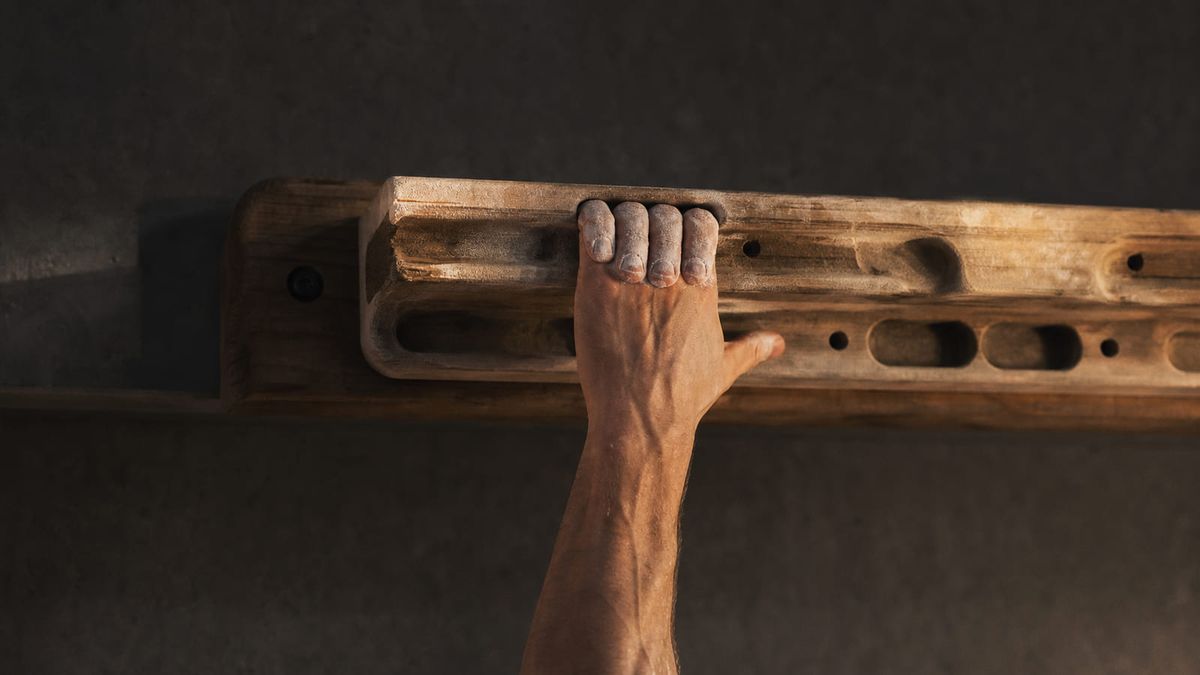
Hangboard training builds finger strength through controlled isometric hangs. Three methods cover almost everything a boulderer needs: max hangs for maximum strength, repeaters for strength-endurance, and density hangs for conditioning and rehab. Train two to three times a week with at least 48 hours between sessions. The evidence is unusually strong for a climbing-specific method — and unusually clear about what does not work.
Key takeaways
- Max hangs produced up to 34% improvement in strength-endurance over 8 weeks in 26 sport climbers averaging 7c+/8a (López-Rivera & González-Badillo, 2019).
- The 7/3 repeater protocol reported roughly 21.5% over 4 weeks and 32% over 8 weeks in the Anderson brothers’ programming.
- Adding weight beat shrinking the edge: Mundry et al. (2021) randomized 30 UIAA VI–VIII climbers and the added-weight group significantly out-improved both minimum-edge and control groups (p = 0.032).
- Intensity picks the adaptation: at 100% of maximum finger strength you build max strength; at 60–80% you build endurance (Frontiers, 2022).
The three hangboard methods
Max hangs load the fingers at roughly 85–95% effort for a single 5–10 second hang, 4–6 sets, with 3–5 minutes of rest between them. The long rest is the point, not a luxury: you are training the nervous system’s ability to produce force, and a fatigued set trains something else entirely. This is pure strength work.
Repeaters run the 7/3 protocol — 7 seconds on, 3 seconds off, six cycles, and those six cycles are one set. The short rest never lets the forearm clear, which is exactly what makes it strength-endurance work. It was popularized by the Anderson brothers in The Rock Climber’s Training Manual and remains the most widely copied hangboard block in climbing.
Density hangs, also called long-duration hangs, sit at 30–60 seconds under 30–70% intensity — the range Lattice Training uses for conditioning. Nobody gets strong from them in the max-strength sense. What they do well is build capacity, introduce an unfamiliar grip position gently, and carry load during rehab when a maximal effort is out of the question. They are also the one method you can run on a day when the rest of you is tired, because the intensity ceiling is low enough that a bad day does not turn into a bad decision.
The three are not interchangeable, and the difference is not a matter of taste. A max hang and a repeater set can use the same edge, the same grip and roughly the same amount of your afternoon, and still produce different adaptations, because what your fingers respond to is the intensity and the rest, not the equipment. Picking one because it is the one you have heard of is how most hangboard plans go wrong: a climber who wants raw strength grinds through repeaters for a season and gains endurance they did not need.
If you want the wider menu of finger-strength work — block pulls, lifting edges, the lot — the five exercises worth programming covers the ones with real evidence behind them.
What the research actually shows
López-Rivera and González-Badillo (Journal of Human Kinetics, 2019) compared 8-week protocols in 26 sport climbers with a mean level of 7c+/8a. Max hangs produced up to 34% improvement in strength-endurance — a large effect for athletes already climbing at that level, which is the part worth noticing. Trained fingers still respond. An earlier 4-week study in the same line reported roughly 35.8% gain with added weight.
Mundry et al. (Scientific Reports, 2021) put the two competing progression strategies head to head. Thirty climbers at UIAA VI–VIII were randomized to added-weight training, minimum-edge training, or a control group. The added-weight group significantly out-improved both others on overall grip strength (p = 0.032). The practical reading: when a 20 mm edge stops being hard, hang more weight from your harness before you reach for a smaller edge. Weight is a linear, measurable, reversible variable. Edge depth is none of those things, and it changes the joint angles your fingers work at.
The 2022 Frontiers instrumented-hangboard study separated the two adaptations cleanly. Training at 100% of maximum finger strength (F100) and at 80% both raised maximum strength; 80% and 60% raised endurance. Intensity, not exercise selection, is what decides which quality you build.
Two consequences follow, and they are the reason this study is more useful than its abstract suggests. The first is that 80% sits in both windows — if you only have one block in you, that is the intensity that buys the most breadth. The second is that a plan without recorded loads is guesswork: you cannot hold an intensity you never measured, and “that felt about right” drifts downward over a six-week block in a way nobody notices from the inside.
Edges, loads and grip position
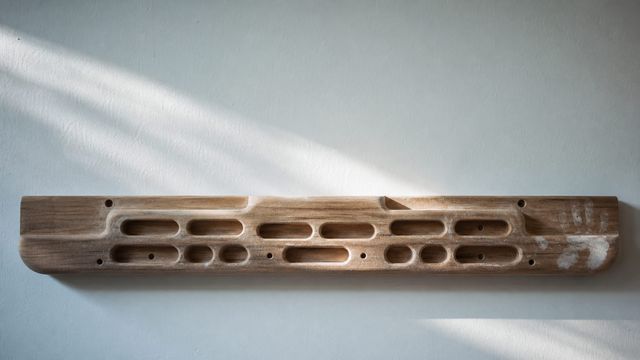
A 20 mm edge is the benchmark. It is the size the research uses, the size most published protocols assume, and deep enough to load the fingers hard without forcing you into the highest-risk position. It is also the reason hangboard numbers are worth logging at all: a load on a 20 mm edge means something to another climber, whereas a load on “the second slot from the left of my board” means nothing to anyone, including you in six months.
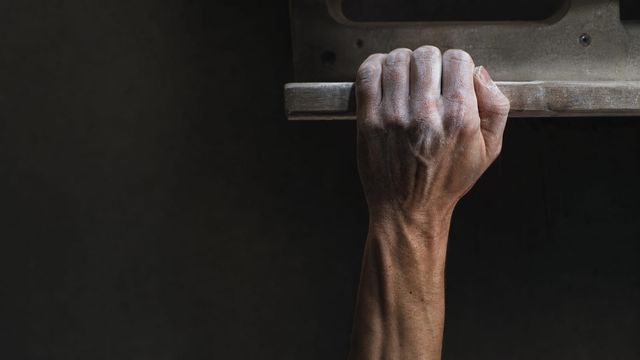
Use the half-crimp as your default training grip. It transfers to most real holds and is far more forgiving than the full crimp, which multiplies the load on the finger’s A2 pulley by a wide margin — the number, and what it means for injury risk, belongs to the article on finger pulley injuries. If you want the biomechanics of why the joint angle matters so much, the comparison of open hand, half-crimp and full crimp lays out all three.
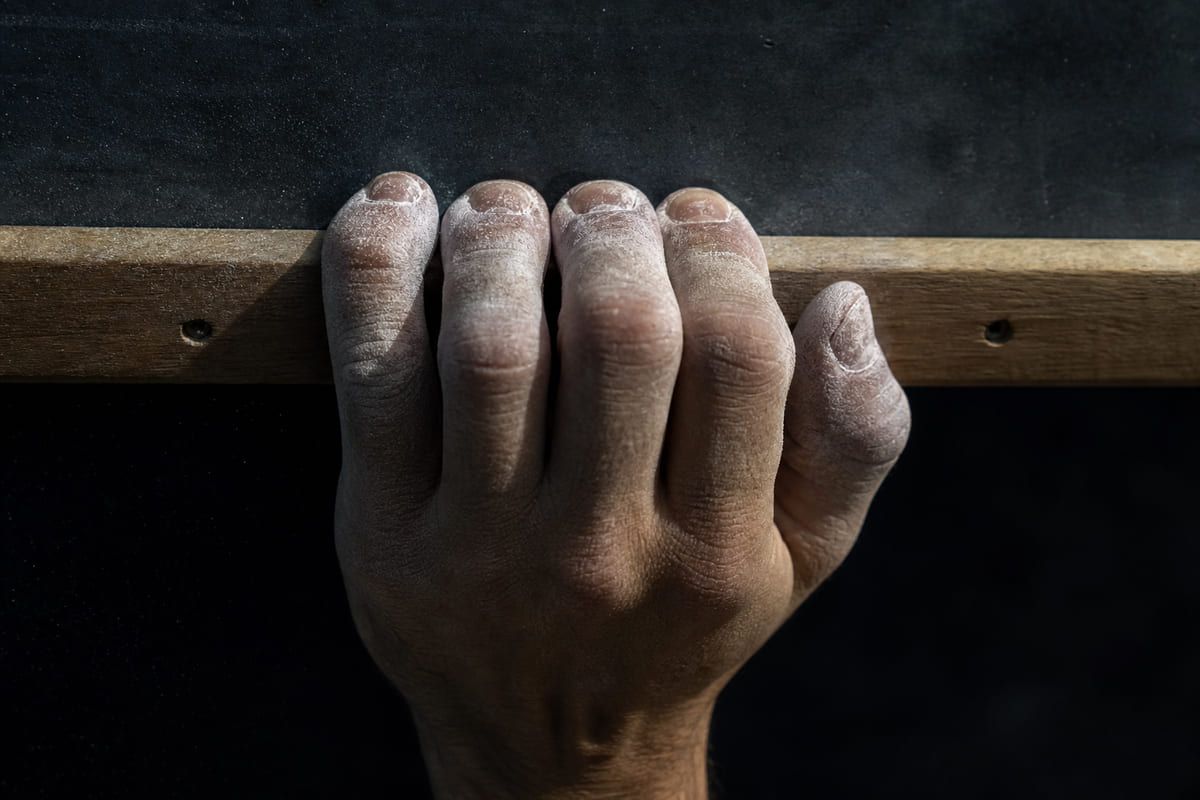
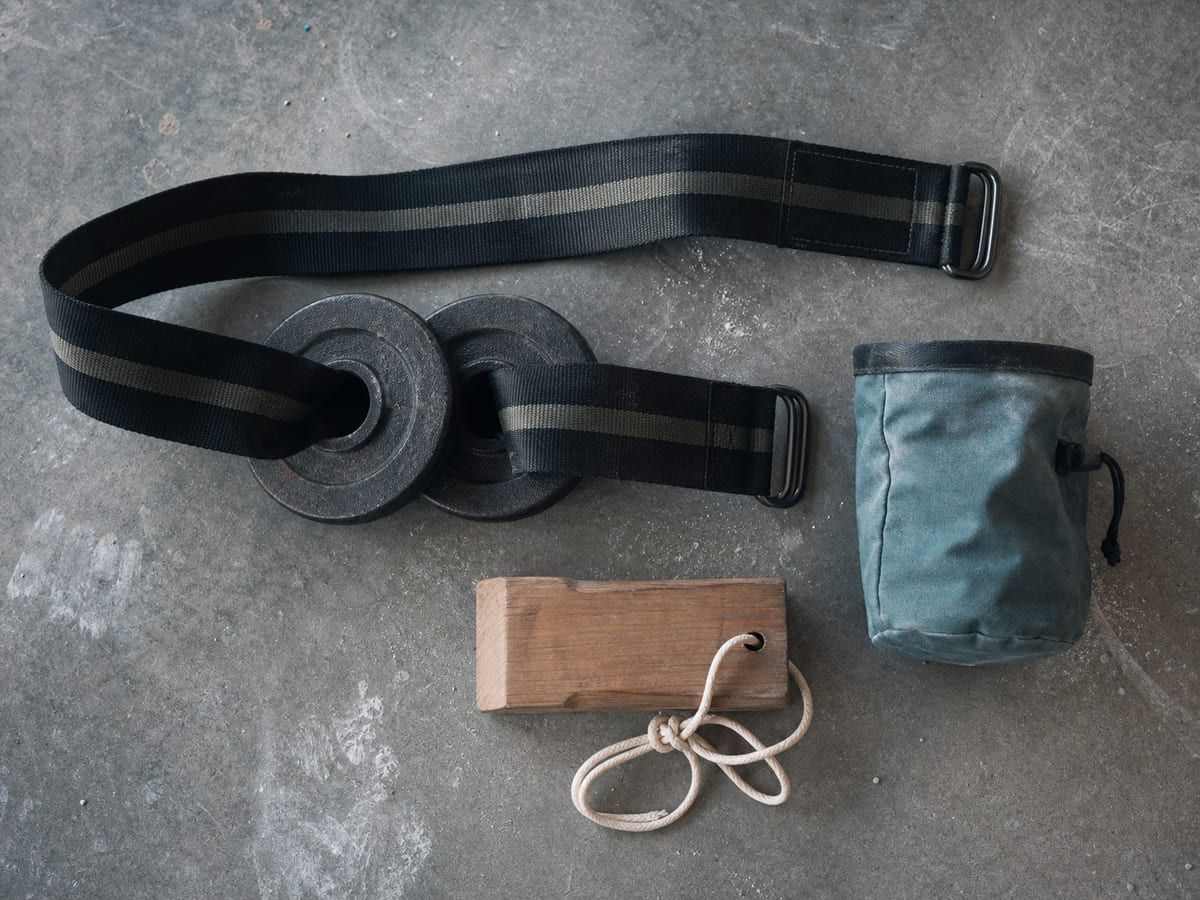
For beginners and for anyone coming back from an injury, a lifting edge or no-hang block is the better tool. You load it from the floor with a loading pin, which means you can set the weight to the kilogram, and you can put it down the instant something feels wrong. A hangboard gives you neither of those: bodyweight is the floor whether your fingers agree or not, and the only way out of a hang that has gone wrong is to drop off it.
Eva López’s minimum-edge protocols run edges as small as 8–10 mm. They work, and they belong to fingers with years of accumulated load behind them. The common mistake is to read “minimum edge” as a difficulty setting and step down to a 10 mm edge as soon as a 20 mm one feels easy — which is exactly the choice Mundry’s added-weight group did not make, and exactly the choice that puts the smallest possible contact area under the highest possible load.
Warm up — never skip it
Fifteen to twenty minutes, every session, no exceptions: light cardio to raise tissue temperature, band work for the shoulders, then progressively harder easy hangs until the fingers feel switched on rather than surprised.
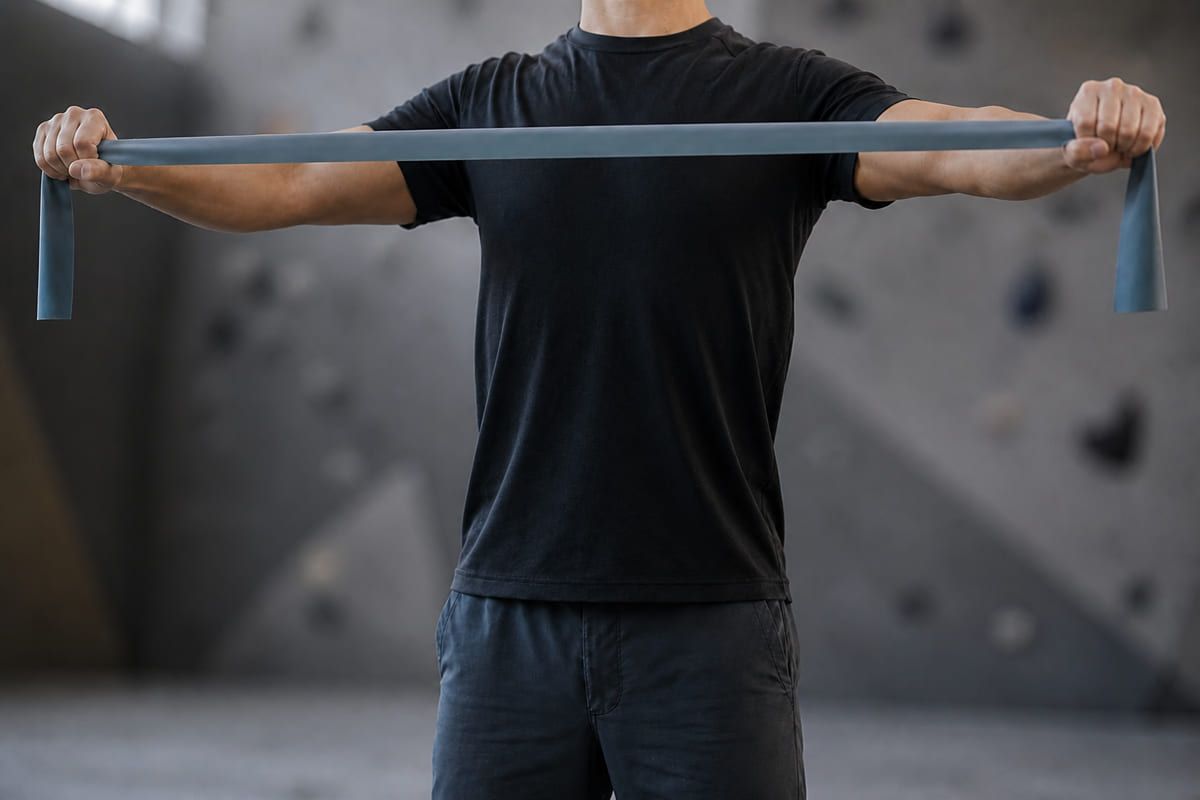
The order matters, and so does the mechanism. Cold connective tissue is stiffer and tolerates less before something gives, and the fingers are the part of you furthest from your core and the last to warm through — so the tissue carrying the highest loads in the session is the tissue that is coldest when you start. Going straight to a working set is not a shortcut, it is the mechanism behind most avoidable finger injuries: cold fingers on small edges is how pulleys tear.
Twenty minutes at the start of a session costs you one session. Getting it wrong costs you a season.
A safe first protocol
Twice weekly, at least 48 hours apart, on a 20 mm edge, in half-crimp.
After the full warm-up, do a no-hang or assisted repeater block: 7 seconds on, 3 seconds off, six cycles per set, three sets, at a comfortable RPE 6–7. That is deliberately submaximal. The first block is not there to make you strong; it is there to find out how your fingers respond to being loaded on a schedule, which is information you do not currently have. Repeaters are the right entry point for the same reason they are the right rehab tool — the 7-second hold is short enough that a bad position gets corrected on the next cycle instead of at the end of a 10-second maximal effort.
Log every set — the load, the edge, the grip, how it felt. Progressive overload is the one variable that random climbing cannot give you, and you can only apply it to numbers you wrote down. Two identical-looking sessions three weeks apart are the whole point; without a log you cannot tell whether you did the same work twice or quietly got weaker.
Two more things decide whether this works over months rather than weeks. The first is that your hangboard days are not the only days your fingers are working hard — how often you can actually hangboard goes through that accounting. The second is planned recovery; a deload week is when the adaptation you trained for actually shows up.
Sources
- López-Rivera, E. & González-Badillo, J. J. (2019). Journal of Human Kinetics, 66, 183–195.
- Mundry, S. et al. (2021). Scientific Reports, 11, 13530.
- Instrumented hangboard training study (2022). Frontiers in Sports and Active Living
- Anderson, M. & Anderson, M. The Rock Climber’s Training Manual.
Common questions
Is hangboarding safe for beginners?
Not in your first year. Finger tendons and pulleys adapt more slowly than muscle, so climbers with under roughly 12 months of consistent climbing get more from climbing volume than from a hangboard. After that, start light — big holds, no added weight, low intensity.
Max hangs or repeaters?
Both, in different phases. Max hangs are near-maximal 5 to 10 second holds with 3 to 5 minutes of rest and build pure strength. Repeaters run 7 seconds on, 3 seconds off, six times per set, and build strength-endurance. Periodize them rather than mixing them in one session.
How long until hangboard training shows results?
Measurable gains appear within a single 4 to 8 week block. López-Rivera and González-Badillo reported up to 34 percent improvement over 8 weeks with max hangs, and the Anderson repeater protocol reported roughly 21.5 percent over 4 weeks and 32 percent over 8.
What edge should I use on a hangboard?
A 20 mm edge. It is the standard benchmark size and the standard training size, deep enough to load the fingers hard without forcing a full crimp. Smaller edges of 8 to 10 mm belong to minimum-edge protocols and to experienced fingers only.

Jan Luther is a climber and the developer behind Boulder Trainer, the hangboard app with guided workouts, voice coaching and a habit tracker.
Keep reading
How Often Should You Hangboard? The Research
Two to three sessions a week, 48 hours apart — but the real answer depends on your total finger load, not just hangboard days. Here's what the studies actually say.
Finger Strength Training: 5 Best Exercises for Climbers
Finger strength is the single best predictor of climbing grade. Here are the five exercises with the strongest evidence — and how to program them safely.