


Climbing grades convert only approximately between systems. Each scale was built independently by a different community. For bouldering the two global standards are Fontainebleau (Font) in Europe and the V-Scale in North America: V0 ≈ Font 4, V3 ≈ Font 6A–6B, V6 ≈ Font 7A, V9 ≈ Font 7C, V13 ≈ Font 8B. Research uses the IRCRA Reporting Scale instead, which turns each grade into a single integer.
Key takeaways
- The anchor conversions worth memorizing are V0 ≈ Font 4, V6 ≈ Font 7A and V13 ≈ Font 8B; everything between them follows the same pattern of one V step per one or two Font steps.
- IRCRA gives every grade one integer so it can be averaged: V0 = 12, V6 = 20, V15 = 31 (Draper et al., 2016).
- German gym levels are gym-specific: Boulderwelt runs Levels 1–9 from Font 2a–3b up to 7b+ and beyond, while Block Barock in Fulda puts Level 5 at Fb 6a–6b and Level 9 at Fb 7c–8c.
- Top-end integers can differ by one, because Frontiers (2024) notes the IRCRA scale “has been increased by one since the first ascent of the V17 (9A) boulder route Burden of Dreams.”
Why climbing grades never convert perfectly
Grades are community consensus, not measurements. Nobody meters a boulder problem. A first ascensionist proposes a number, later climbers argue about it, and the grade settles wherever enough people agree. Two systems built by two communities on two different sets of rock were never going to line up cleanly, because there was no shared reference to line up against.
Style is the biggest source of drift. A V5 slab, a V5 roof and a V5 crimp ladder can feel completely different to the same climber on the same afternoon. Height, skin and temperature move perceived difficulty further still. A tall climber who skips a reachy move and a short climber who invents a heel hook are not really climbing the same problem, whatever the sign at the base says.
Conversions are most reliable in the mid-range and diverge at the very top. The mechanism is sample size. A Font 6B has thousands of ascents behind it, and the consensus has been sanded smooth by every one of them, while the hardest boulders on earth have a handful of repeats and sometimes none at all. With five opinions instead of five thousand, a grade is still a hypothesis.
So read every conversion as a band, not a point. If a chart tells you V5 is 6C/6C+, the honest reading is that a V5 usually lands somewhere in that region for a climber used to that style. The common mistake is treating a half-grade disagreement as an error in the chart. It is not an error. It is the resolution limit of the entire idea.
Font vs V-Scale — the two global bouldering systems
The two global bouldering systems differ mainly in granularity. The V-Scale was invented by John Sherman in the late 1980s and named after his nickname, “Vermin.” It runs from V0 upward in clean whole numbers to V17. The Fontainebleau scale runs from around 3 through 9A and uses a number plus a letter, with a plus sign for the half steps: 6A, 6A+, 6B, 6B+.
Count the steps and the gap shows immediately. Where the V-Scale gives you one number, Font often gives you two. V2 covers 6A and 6A+, V5 covers 6C and 6C+, V9 covers 7B+ and 7C. That is not sloppiness in the chart. It is Font carrying finer resolution through the middle of the range, which is exactly where most climbers spend most of their climbing lives.
The consequence for your logbook is that Font to V loses information and V to Font invents it. Converting 6C+ to V5 is fine. Converting V5 back to Font is a coin flip between 6C and 6C+, and if you make that round trip a few times across a season, your recorded progress starts to depend on which direction you converted last. Log the grade the problem was actually given, then convert for display.
One thing to get straight: Font bouldering grades are not French sport grades. They share the notation, which is why the mistake is everywhere. A Font 7A boulder and a French 7a route describe different efforts on different kinds of climb, and a number that arrives without its discipline attached is not yet a grade.
The German gym 1–9 level system
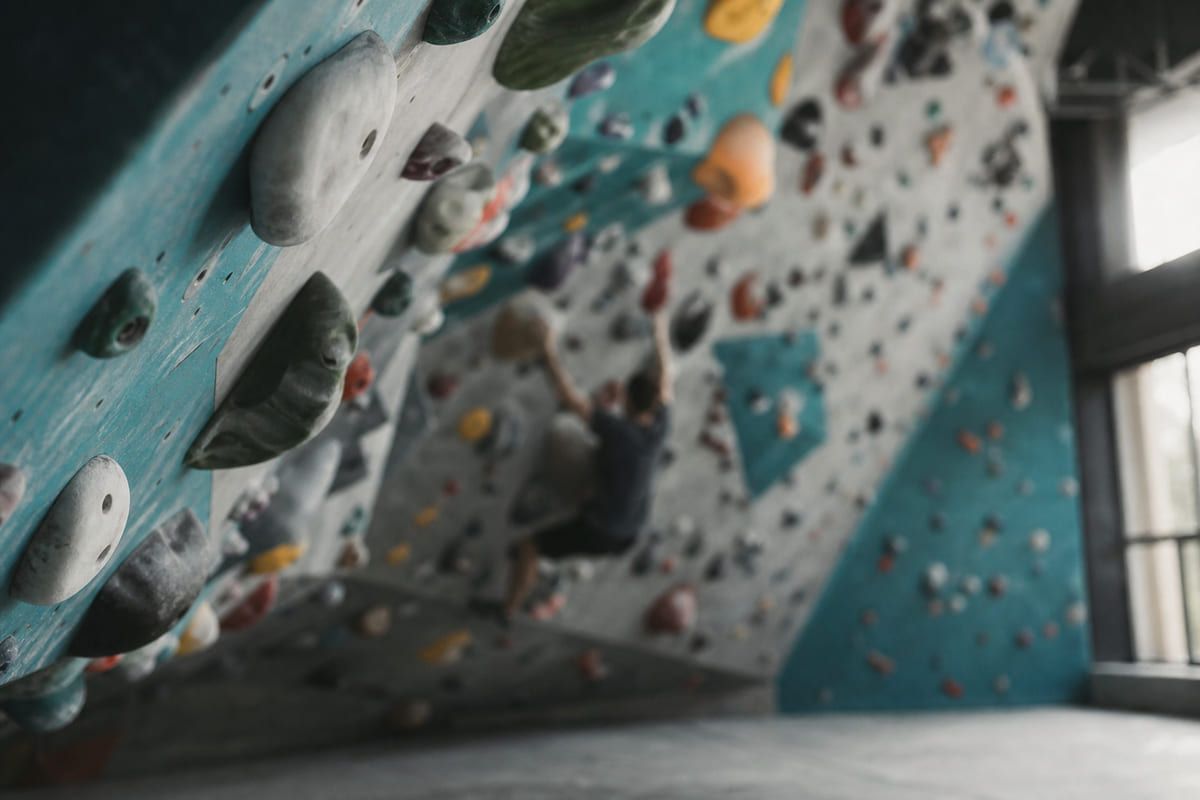
Many German bouldering gyms rate problems with an abstract numeric level instead of a Font grade, and each gym defines its own bands. Boulderwelt, which runs gyms in Frankfurt, München and elsewhere, uses Levels 1–9: Level 1 is Font 2a–3b, Level 9 is everything from Font 7b+ upward, and the middle bands are deliberately left unpublished. Block Barock in Fulda publishes the full 1–9 table instead, with Level 3 = Fb 4–5, Level 5 = Fb 6a–6b, Level 7 = Fb 7a–7b and Level 9 = Fb 7c–8c.
Put those two next to each other and the problem is visible without any further argument. Both scales run 1 to 9, both belong to German bouldering gyms, and their top band does not even start in the same place: 7b+ at Boulderwelt, 7c at Block Barock. Bergzeit notes that some halls use an even simpler abstract “1 to 8” number scale, and warns that these “can hardly be converted” to Font reliably.
There is a reason gyms do it. An abstract level lets setters rebuild a circuit at a slightly different difficulty without renaming anything, and it keeps beginners from attaching their self-image to a number that strangers will judge. That is sensible gym design and a poor basis for tracking progress between gyms.
So read the sign at reception. The level system means something inside that one building and nowhere else. It also matters beyond bragging rights: the readiness rules climbers use to decide when structured training is appropriate are written in Font or V grades, never in levels, so you need at least a rough translation before the split between beginner and advanced training plans applies to you.
The IRCRA scale — how researchers compare grades
The IRCRA Reporting Scale turns any climbing grade into a single integer so grades can be used in statistics. The International Rock Climbing Research Association published it in the IRCRA Position Statement (Draper et al., Sports Technology, 2016) to fix a problem that had dogged climbing research for years: some participants report Font, some report the V-Scale, and neither notation can be added, averaged or plotted.
Integers can. V0 is IRCRA 12, V6 is 20, and V15 is 31. Take two climbers, one at V6 and one at V8. In notation you have “7A and 7B” and no way forward. In IRCRA you have 20 and 22, which average to 21, which is V7. That single move is what makes a table of climbers into a dataset, and it is why almost every recent climbing study reports IRCRA numbers alongside the grades its subjects actually climb.
One wrinkle sits at the top of the scale. A 2024 paper in Frontiers in Sports and Active Living notes that the scale “has been increased by one since the first ascent of the V17 (9A) boulder route Burden of Dreams,” so elite integers can differ by one depending on the source. If you are comparing two papers at that end of the range, check which version each used before you trust the difference.
For a logbook the payoff is the same one researchers get. Boulder Trainer uses IRCRA under the hood so your history stays comparable whether a session was logged in Font or in V. An integer grade is only as useful as the numbers you record beside it, which is the same argument that makes the three hangboard methods and the loads they use worth writing down.
The full conversion chart
Here is the chart. Every row is an approximation, and the German column is the loosest of the four.
| V-Scale | Font | IRCRA | German gym level (approx.) |
|---|---|---|---|
| V0 | 4 | 12 | 2–3 |
| V0+ | 4+ | 13 | 3 |
| V1 | 5 | 14 | 3–4 |
| V2 | 6A / 6A+ | 16 | 4–5 |
| V3 | 6B | 17 | 5 |
| V4 | 6B+ | 18 | 5–6 |
| V5 | 6C / 6C+ | 19 | 6 |
| V6 | 7A | 20 | 7 |
| V7 | 7A+ | 21 | 7 |
| V8 | 7B | 22 | 8 |
| V9 | 7B+ / 7C | 23–24 | 8–9 |
| V10 | 7C+ | 25 | 9 |
| V11 | 8A | 26 | 9 |
| V12 | 8A+ | 27 | 9+ |
| V13 | 8B | 28 | 9+ |
| V14 | 8B+ | 29 | 9+ |
| V15 | 8C | 31 | 9+ |
IRCRA integers from Draper et al. 2016 / wulfmann-ircra dataset. German level column is an approximation aligned to the Boulderwelt and Block Barock published bands — treat as indicative only.
Two details in the table are worth reading twice. The IRCRA column skips 15, which is a property of the published anchors rather than a typo, and it jumps from 29 to 31 at the top for the same reason. The V9 row carries a range in two columns at once, 7B+/7C and 23–24, which is the chart telling you honestly that consensus has already started to thin out at that grade.

Use the chart to translate, not to judge. The one number on it that should change your training is the one you keep failing to reach: a grade you fall off in the same way every time is a diagnosis, not a verdict, and it usually points at one limiter. If that limiter is your fingers, the finger-strength exercises worth programming is the next place to look. If it is technique or tactics, no conversion chart will help, and neither will a smaller edge.
Sources
- Draper, N. et al. (2015/2016). Comparative grading scales, statistical analyses, climber descriptors and ability grouping: IRCRA position statement. Sports Technology, 8(3–4).
- IRCRA integer anchors: wulfmann/ircra dataset (V0 = Font 4 = IRCRA 12 … V15 = Font 8C = IRCRA 31).
- Frontiers in Sports and Active Living (2024), article fspor.2024.1512010.
- Boulderwelt (Frankfurt / München). Published gym Levels 1–9.
- Block Barock Fulda. Published gym Levels 1–9 table.
- Bergzeit. Grade overview on abstract gym level scales.
Common questions
Is Font the same as French sport grades?
No. Font bouldering grades and French sport grades share the same notation, which is why the two get confused, but they describe different disciplines. A Font 7A boulder and a French 7a route are not the same effort, and a grade that arrives without its discipline attached cannot be converted to anything.
What is V5 in Font?
V5 converts to roughly Font 6C or 6C+, which is 19 on the IRCRA research scale. Like every grade conversion this is a band rather than a point. A V5 slab and a V5 roof can feel a full grade apart to the same climber, and no chart knows which one you are standing under.
Why is my gym softer than this chart?
Commercial gyms often drift a half to a full grade soft below V5, because early progress keeps new climbers coming back. That is a setting decision, not a mistake in the conversion chart. Compare your gym grades against the same gym over time, and use outdoor problems when you want an absolute reference.
What is IRCRA used for?
The IRCRA Reporting Scale turns any climbing grade into a single integer, so researchers can average and compare results from studies where some climbers report Font and others report the V-Scale. Training apps use it for the same reason, keeping one logbook comparable across both notations.
Do German gym levels match Font exactly?
No. Every German gym sets its own bands and some leave the middle of the range unpublished. Boulderwelt puts Level 1 at Font 2a–3b, while Block Barock in Fulda puts Level 5 at Fb 6a–6b. Read the conversion sign at reception; a level number only means something inside that one gym.

Jan Luther is a climber and the developer behind Boulder Trainer, the hangboard app with guided workouts, voice coaching and a habit tracker.
Keep reading
Hangboard Training: The Complete Guide for Boulderers
Everything a boulderer needs to train fingers safely: the three main hangboard methods, the research behind them, load and edge guidelines, and a beginner-safe first protocol.

Finger Strength Training: 5 Best Exercises for Climbers
Finger strength is the single best predictor of climbing grade. Here are the five exercises with the strongest evidence — and how to program them safely.